Will The Ongoing Title Conversions Affect Your Land Ownership Rights?

If you own a piece of land in Nairobi, including an interest in land situated within Nairobi County (and eventually across the country) then you need to be appraised on the recent development of title conversions.

Context: What Necessitated The Title Conversions?

Despite the seeming suddenness of the title conversion process, it is deeply rooted in the land management and administrative reforms that have happened in Kenya prior to and since the enactment of the Constitution of Kenya 2010.

The title conversion process will be implemented in phases (batches) across all land registries in the country as an integral component of the social and administrative reforms that were envisaged by the enactment of the Constitution of Kenya 2010 which saw the introduction of new legislation designed to establish more efficient administration and management of land, curb the incidences of land fraud and introduce greater efficiency in the conduct of property transactions.

The Government of Kenya took the decision to implement these reforms as a key aspect of the country’s Vision 2030 agenda which is implemented through five-year Medium Term Sector Plans. Among the reforms include the modernization, expansion and increase of land registries, the development of a National Land Information Management System, the establishment of a Land Records Conversion Centre (LRCC) for the digitization of land records, the land adjudication and titling programme which is a social reform measure which bequeaths especially small landholders greater autonomy and benefits of land ownership, preparation of a National Spatial Plan and County Spatial Plans, land cover and land use mapping – which includes the revision of topographical and thematic maps, the review of physical and land tenure profiles, the establishment of Special Economic Zones and a myriad other reforms.

See the Sector Plan for Land Reforms 2013-2017.

Title Conversion was the natural progression from the consolidation of land laws in the country and was envisioned as an integral activity of the flagship project to establish a National Land Title Register under the Vision 2030 Sector MTP of 2013-2017, in accordance with the Land Registration Act, 2012.

The National Land Title Register would be established to contain all land records in the country with the conversion of existing land under various land registration statutes to the Land Registration Act, 2012 being one of the activities that would be implemented.

The conversion would also facilitate the transfer of the converted land records to the county land registries for improved service delivery, planning and efficiency and the issuance of both manual and digital certificates of title, as well as providing a more efficient mechanism for the resolution of land fraud and disputes.

Title Conversion: The Rollout Process

Prior to the Land Registration Act, 2012, land registration was done under several legislations that included the Registered Land Act (RLA), the Registration of Titles Act (RTA), the Land Titles Act (LTA), and the Government Lands Act (GLA), all of which have since been repealed by the enactment of the Land Registration Act, 2012.

As of the date of publishing this blog piece, there are already four Gazette notices (No. 11348 issued on 31 December 2020, No. 520 issued on 26 January 2021, No. 1706 issued on 23 February 2021 and No. 1707 also issued on 23 February 2021) issued pursuant to regulation 4 (4) of the Land Registration (Registration Units) Order, 2017, by the Cabinet Secretary for Lands and Physical Planning, notifying the general public that land reference numbers within the jurisdiction of the Nairobi Land Registration Unit have been converted to new parcel numbers.

The implication is that all transactions or dealings relating to the parcels with converted registration details shall from April 1, 2021, be carried out in the new registers. Currently, the batches against which conversion lists and cadastral maps have been issued to date only affect land held under the Nairobi Land Registration Unit.

What Will the Effect of Title Conversion be on Current Land Ownership?

In essence, the effect of the conversion will be the issuance of new title deeds under different/new registration numbers with the purposed of unifying and consolidating the registers under these hitherto laws which have since been repealed and then place the registration under a unitary law—the Land Registration Act, 2012.

It is noteworthy to mention that the conversion of titles is deemed to be purely an administrative change and is not expected to occasion the alteration of land sizes, nor to interfere with the ownership rights or in any way take away any obligations or interest thereon.

The administrative goals of the conversion are many but it is envisaged that the title conversion will reduce the complexity of land registration in the country not only in the hopes that land fraud can be reduced, but to also introduce greater efficiency at the registries.

The conversion process will eventually be rolled out all across the country and will, with each batch, involve the preparation of cadastral maps alongside a corresponding conversion schedule detailing both the old and new title numbers for all the parcels of land within the registration unit/section/or block with the corresponding sizes of each of the units on that cadastral map. The Cadastral maps will be detailed and will include information on ownership, size of the parcel and any changes that have occurred in the proprietorship of the property.

Title Conversion: What Happens To Title Documents Issued As Security?

The registered owner (proprietor) of the land is required to liaise with the parties that have a secured interest in the property to apply for the replacement which shall nonetheless have any prior registered interests noted in the registry.

Title Conversion: What Should You Do If Your Property is on a Title Conversion List?

  • Note the new title registration number and keep a record of it.
  • Compare the record of the new title registration number to the property details in the cadastral map with the record of your current title to ensure that they match. Note that ownership, size, and any interests registered against an old title will not be affected.
  • In the event that there are discrepancies noted, you may proceed to lodge a complaint with the Registrar of Lands. Upon the issuance of a gazette notice for title conversion, any person with an interest in land within the registration unit who is aggrieved by the information in the conversion list or the cadastral maps has 90 days from the date of the gazette notice to make a complaint in the prescribed format to the Registrar or to apply to the Registrar in the prescribed format for the registration of a caution pending the clarification or resolution of any complaint. The Registrar is required to resolve the complaint within 30 days of the same.

It is important when a gazette notice is issued to effect title conversion, that the proprietor or anyone with interest in the property, ensure the details of their land are correct.

However, a landowner or any person with an interest in a parcel of land listed for conversion, who may feel aggrieved by the changes to the land reference numbers, has the right to make a complaint to the Registrar of Lands.

Title Conversion: What Process Shall You Follow To Receive Your New Title

After lapse of the 90 day notice period, you will be required to surrender your current title using the prescribed procedure (provided for in the Gazette Notice specific to the conversion list in which your property appears) in order to receive your new title deed with the new title number. The notice and procedure for the surrender their current titles will be issued by the Ministry of Lands will

As a proprietor of the land you will be required to submit to the Registrar of Lands a completed Form LRA 97 with the original title deed alongside certified copies of your identification (individuals) or certified copies of the certificate of incorporation and identification documents of the directors or partners if the property is registered in the name of a corporate entity.

Due to the large number of fraud cases associated with land transactions in the country, the move to introduce the reforms and to effect the administrative changes occasioned by the changes in law was always going to be met with some degree of suspicion. However, the Ministry of Lands has gone to great lengths to assuage these fears and even offer clarifications on what the changes actually mean, and how they will be effected

In line with the land registration process now being managed and administered under a unitary legislative framework, the Land Registration Act, 2012, deed plans (Survey Maps) will effectively be replaced by what will called Registry Index Maps. Currently, you can buy survey maps from the Department of Surveys under the Ministry of Lands and Physical Planning. The same will be true for the Registry Index Maps. The key distinction between the two will be that with the Registry Index Maps, all land parcels within an area will be displayed on the map unlike deed plans which only display the records of a single parcel.

Each proprietor and anyone with an interest in land affected by the changes, as they occur, needs to inform themselves about the changes and how those changes will affect them. This means that in due course, as more and more registration units across the country are folded into the title conversion process, the general public will need to be aware of the process and to ensure that they eventually secure their rightful ownership documents.

While the title conversion process has already rolled out in Nairobi County, it is expected to take 2 years to migrate from the old system of land registration to the new process across the entire country, with all the registration units across the country completing their conversion lists and cadastral maps for the same by December 2022.

Active Political Goodwill Sorely Required to Achieve Land Reforms in Kenya

Prior to the enactment of the Constitution 2010, the Government of Kenya began to take robust and progressive steps towards land reforms in the country, addressing many of the lingering issues on the administration and management of land in the country through a raft of new legislative, policy and administrative reform measures. Land, after all, was one of the fundamental cornerstones of the country’s independence struggle.

Land Reforms in Kenya: Ndung’u Land Commission

Among the many initiatives undertaken included the establishment of the Ndungu-led Commission of Inquiry into Illegal/Irregular Allocation of Public Land in June 2003. While this commission had its predecessors, it was perhaps the most comprehensive, authoritative and widely regarded endeavour at establishing the corrupt, historic and systemic malpractices in Kenya’s system of land tenure, specifically regarding public land and its misappropriation by the ruling class. The commission released a report at the conclusion of its mandate which reveals the scale of corrupt practices in land allocation that have largely benefited the political class in the country, and a whole litany of challenges within Kenya’s land tenure and administrative systems dating back to the legacy of our country’s colonial days, the exploitation and manipulation of legal loopholes and improprieties of the ruling class in the immediate post-independence period and onward to the time the report was prepared. To its credit, the Ndungu Commission did an extensive and thorough exposé on the systematic way in which established public land administration procedures which were designed to protect the public interest, were leveraged and grossly perverted to serve the interests of shadowy private and political figures.

It is worth mentioning that the full report has never been made publicly available due to its indictment of the country’s ruling elites.

Land Reforms in Kenya: Formulation of National Land Policy

Simultaneously, the formulation of a National Land Policy involving the full spectrum of stakeholders commenced in earnest in 2004 and culminated with approval of the Draft National Land Policy (2007) and preparation of Sessional Paper No. 3 of 2009 on the National Land Policy for presentation to Parliament in June 2009.

All these efforts were geared toward the much-needed land reforms in Kenya that were envisaged to bring the country into a more equitable society where the rights and freedoms guaranteed under the new constitution would be attained.

Along the way, however, land reforms in Kenya have faltered or been still-birthed – held captive to the political machinations of successive regimes. To understand why, one might find clues in the political and elite class’ illegal allocations and theft of public land and their domination in terms of private land ownership. The fish truly rots from the head!

Land Reforms in Kenya: Legal, Policy & Institutional Reforms

These reforms required to be anchored in legal, policy and institutional frameworks, improved administrative processes and efficient management structures. It also required bold measures by the executive to address the past corruption, a herculean task by no means because the names involved, particularly in the illegal allocation of public land, span the breadth of Kenya’s political bigwigs and dynasties.

The administrative land reforms and initiatives thus far have been, to some considerable extent, inclusive and consultative, taking into account multi-sectoral stakeholder inputs from the public, private and civil society organizations, as well as expert opinion in arriving at the raft of measures recommended for land reform in the country.

Land Reforms in Kenya: Progressive Gains

While the reforms that have taken place cannot be dismissed as paltry, they could be described as slow, perhaps even token. Notably, there was the passing of the Matrimonial Property Act, 2013, which ensures greater protection over matrimonial property for the benefit of both spouses and brought in some degree of social equity, in particular for women who were hitherto disadvantaged in matters of family property.

Indeed, in terms of administrative reforms and the improvement of service delivery, there have been huge strides taken forward including the digitization of land records in some registries and steady progress toward rolling out of the land information management systems (LIMS). In the past 10 years as well, a vast majority of the legislative and policy reform agendas and milestones have been achieved. The Ministry of Lands and Physical Planning has also put developed a raft of regulatory proposals and draft policy frameworks all geared towards administrative reforms.

However, the underlying measures to bring greater equity in the distribution of land resources in the country have hardly taken root. There are established pathways for the progress towards land reforms but the pace at which the impact of these reforms will be felt is in great part dependent and hinged on political goodwill.

The bigger question, with a clear overview of Kenya’s murky history on this issue as detailed in the Ndungu report, is whether successive governments are willing to pay the political price for what these reforms will ultimately cost. It is unlikely that they will because those who stand to lose the most out of the reforms process are the very ones of whom reforms are demanded.

This legacy is likely to just be passed on from one government to the next. Certain changes might happen, but the real issues that have brought about inequality in land justice and reform might take longer to bring to resolution.

A good example to illustrate this point would be the stagnation of the bill on the minimum and maximum land holdings which was one of the most contentious issues during the process of enactment of the Constitution of Kenya 2010.

Five years after the law was drafted in line with the mandate of the Constitution Implementation Commission (CIC), the bill is yet to come to life in legislation as was envisaged by the constitution. With the rushed timeline that the CIC had to complete their mandate, the proposed bill was not subjected to public participation. The process by which the bill was developed lacked sufficient stakeholder engagement and was reputedly hurried through without significant research implying that certain thresholds on transparency, accountability and good governance would not be met as anticipated by the constitution. Given the constraints, it is debatable whether the CIC could have achieved more. Certainly, it is telling of the current government’s political goodwill to complete some of these pending tasks in service to the goals of land reforms.

Unlike most other investment markets in the country, while the real estate market is quite robust, it lacks significant regulation and protection mechanisms across all market segments that can adequately cater to investors. For example, capital markets have a unitary regulator, the Capital Markets Authority while traditional lenders of financial products (mortgages) are governed through existing frameworks of regulation on banks, specifically the Central Bank of Kenya. However, there are currently myriad investment products in the real estate market that sold on the open market that are not regulated except only by self-regulation mechanisms.

For instance, off-plan investment schemes and other non-regulated financial products may be benchmarked against industry-practice but the channels for redress to investors when property developers fail to deliver are negligible. Much more needs to be done to rein in other players including marketers and advertisers, property developers, industry consultants (valuers, property agents, architects, lawyers and engineers).

Back to the issue of minimum and maximum holdings, some context is required to understand why this was a critical concern at the formulation of Kenya’s Constitution 2010. For the rural masses often living in poverty and even for many families that might be considered as middle class, land is primarily a resource for the sustenance of livelihoods. They perceive and use land for economic productivity and for self-sustenance. However, for those in the upper echelons of society, land is primarily a store of value, for the accumulation of capital gains and a tool for the transmission of wealth across generations. It may also be considered a factor of production for them, but the impact on their livelihoods and survival is of far less significance than it is to say a subsistence farmer. This presents the problem that while land is the greatest factor of production, productivity would likely to remain low if land large tracts of land were concentrated in the hands of the few, as it is in Kenya.

Indeed, for the political class who can leverage on national development agendas, there would be a negligible need to focus on land as a factor of production when they could simply steer development in the direction of their holdings and reap off higher land values that come with an increase in settlement. With only 20% arable land, the goals for which the Bill was conceived included the promotion of equitable distribution of land, regulation of subdivision of land to ensure that agriculturally productive zones were retained as such, preservation of ecological zones, creation of employment and reduction of poverty, sustainable utilization of private land and promotion of national security and economic stability.

Without adequate reforms and regulation, the prevailing inequalities will continue to persist. Investors will require to make sound decisions with a clear understanding of microeconomic risks. Stakeholders can do more to proverbially hold the feet of the ruling class to the fire in ensuring that reform and regulation become institutionalized and engineered into the fabric of land administration in Kenya and to protect investments in the marketplace. There is plenty of hard work still left to be done but for the security and heritage of future generations, it will take a radical rethinking of policy and a forward-looking attitude that doesn’t just focus on the legacy of colonialism and the bane of political patronage. Will that happen any time soon? That’s anyone’s guess.

An authoritative report published by the African Centre for Open Governance (Africog) on the progress of the implementation of the Report of the Commission of Inquiry into the Illegal/Irregular Allocation of Public Land (the Ndung’u Commission), and by extension, on the progress of land reforms in Kenya, indicts political actors in implementing the necessary reforms required to address land injustices in Kenya. While much has changed in the 10 years since, there is still very slow progress!

Adverse Possession: Why You Could Lose Your Ownership Rights to Squatters

In the simplest of definitions, adverse possession can be described as the result of what happens when a landowner (titleholder to a property) tacitly allows a “squatter” to live on their property without taking action to enforce their right of ownership over the property over a specified period of time. A squatter, as distinguished from a tenant, is a person who settles on or occupies a property with no legal claim to it.

In Kenya, the Section 7 of Limitation of Actions Act, Chapter 22 of the Laws of Kenya states “An action may not be brought by any person to recover land after the end of twelve years from the date on which the right of action accrued to him or, if it first accrued to some person through whom he claims, to that person.

The same statute, in Section 38(1) states that “Where a person claims to have become entitled by adverse possession to land registered under any of the Acts cited in section 37 of this Act, or land
comprised in a lease registered under any of those Acts, he may apply to the High Court for an order that he be registered as the proprietor of the land or lease in place of the person then registered as proprietor of the land.

The effect of these clauses is simply that anyone who has had continued, uninterrupted use of land which violates the interest of the proprietor of such land for period of up to 12 years, can apply to the High Court in Kenya to have the land registered in place of the original proprietor, in effect having the rights of ownership appropriated to themselves.

Most absentee landowners – whether because they live in-country but far away from their investments, or whether they live abroad – rarely have someone trustworthy who they can assign responsibility for their property. That being the case, many choose to assign the responsibility to a relative or such other nominee until such time as they are available to take possession and undertake some sort of activity on the property. In some instances, the property has been purchased sight unseen and so the actual owner may not even be able to ascertain the physical location, landmarks or dimensions of the property.

With increasing frequency, unfortunately, having built their livelihood on such property, those not expressly appointed with custody, and those who may trespass on another’s property can legally take ownership of such property without further reference to the actual owner (title holder) by the claim of adverse possession.

Where such a custodian is able to meet the standards set out in jurisprudence, they can successfully apply to have your rights of ownership over the property extinguished. The individual needn’t even be someone known to you, the landowner. They only need to meet the prescribed standards determined by the law.

Adverse Possession: Legal Precedent & Effect

The law, in form of judicial precedent, has established that adverse possession is fundamentally a situation where a person takes possession of the land and asserts ownership rights over it while the person having title to it omits or neglects to take any action against such person in the assertion of his title for a certain specified period.

Adverse possession, which is also referred to as “squatter rights”, should not have been asserted by some use of force, neither should it have occurred in secrecy or without the authority or permission of the owner. The law deems that the proprietor of land has consented to such possession if it has occurred within the period stipulated and has occurred openly, continuously and without interruption.

In Black’s Law Dictionary, adverse possession is defined as the enjoyment of real property with a claim of right when that enjoyment is opposed to another person’s claim and is continuous, exclusive, hostile, open and notorious.

The number of judicial precedents that describe adverse possession and the principles required to demonstrate it and those surrounding its determination in law are numerous. And while the individual circumstances may vary from case to case, judicial precedent is highly instructive in determining the conditions against which a plaintiff’s claims can be entertained and the technicalities around the individual case can provide guidance, on the balance of facts, as to how courts are likely to rule on any subsequent matters.

The principles of adverse possession primarily recognize that land is a factor of production and that for this reason, therefore, it would be inequitable to remove the person(s) who has (have) been utilizing the property (within what is often referred to as the statute of limitations), especially where they can prove that they have established their livelihoods on that property and have had unfettered use of the same for the period prescribed in law. The matter for determination by courts is one of equity – ensuring that the rights of the “deemed” owner are not interrupted.

To assert adverse possession, squatters who, for example, erect their home or permanent structures on the property, subdivide the property, fence off the property, connect utility services to the property in their name, conduct some sort of livelihood activities including operating businesses on the property can make and lay claim to such property. In judicial precedent, to assert their claims, squatters on your land will invariably cite raising their families on the property, conducting rites of passage ceremonies (including marriage ceremonies) and even burials on the property.

In effect, adverse possession extinguishes the rights of a titleholder and confers the rights of ownership to the person who has enjoyed unfettered possession of the property for a period of 12 years or more. Simply stated, the one in possession of the property becomes its new owner.

Adverse Possession: Absentee Owners

It is incumbent upon every investor to take measures to protect their assets. Adverse possession proves that it isn’t merely sufficient to hold title to your assets and brings to life the legal maxim that possession is nine tenths of the law! The sad reality of investing in a property only to lose it to squatters is perhaps a most unfortunate happenstance but it is a fate that has befallen many property investors in Kenya.

In most instances today in Kenya, the circumstances that give rise to adverse possession quite often arise without the knowledge of the owner. This is particularly the case with absentee owners, mostly Kenyans residing in what is quintessentially referred to as the diaspora. With the myriad property subdivision schemes all across the country, it is not uncommon for many property buyers – even locals – to buy property, specifically vacant land, in places where they do not live or frequent regularly. Without ascertaining their purchase beforehand, many might typically be unaware of the actual condition of the property, including whether it is actually occupied even at the time they acquired it. Some typically allow the seller to continue using the property in their absence and many acquire property mired in entanglements by failing to undertake proper due diligence or by acquiring property held under letters of allotment (without formal title).

Adverse Possession: How Can You Secure Your Assets?

The most obvious question that many would therefore raise is, “How can one escape such a fate?” The simple answer would be to enforce your rights as an owner, in whatever way, shape or form. Obviously, it would be ideal to simply enforce the right within the law, and of course before the expiry of a period of time where your rights of ownership would become tenuous. In Kenya, that often takes the form of unsanctioned evictions of squatters from the property. In some instances, property owners have taken the law into their own hands by using underhanded tactics, including the wanton demolish of any temporary or permanent structures erected by squatters by whatever means necessary including bulldozing and arson!

But are there more “reasonable” ways to deal with the problem?

It is needless for a titleholder to lose their property due to adverse possession. In this market, most smallholder land is acquired with the view to develop down the road, perhaps construct a residence in the future, or held for a period of time as investments and then eventually disposed to a secondary buyer for capital gains. In the intervening period between the time they are purchased and eventually developed or disposed of, most remain vacant and unused – for the most part, because they are either so highly fractured that they might not be able to viably sustain any robust economic venture or because their owners live at a distance and cannot manage the properties themselves. Enforcing your property rights shouldn’t be too difficult if there was a consideration of some economic activity that the property could sustain, prior to its acquisition, or if you had more than just capital gains in mind at the time of the acquisition, or if your plans to develop the property are not in the too-distant future.

Of course, you may not be able to make predetermination of either of these scenarios at the time, or prior to acquisition. However, there are some other basic measures that you can take to secure your property.

  • You can appoint a manager/trustee to ensure oversight of your property and provide effective reporting of developments in the neighbourhood over the time you hold it. By engaging an independent property manager/custodian over the property and ensuring that you regularly change out such custodians so that at no time has any single individual exercised possession over the property for longer than the period defined in law entitling them to take adverse possession of the land ensures that.
  • Physical deterrents: You can ensure proper demarcation of the property by erecting fencing and even erect temporary structures on the property to deter encroachment and secure your ownership.
  • Undertake some sort of legally contracted commercial activity on the property. You can undertake high-value (but low-impact) projects that don’t require frequent, hands-on project management which can generate handsome returns into the future.
  • Keep up with the payment of any government levies and dues on the property and ensure to keep records of the same demonstrating that you have maintained the privileges of the ownership of the property.
  • Depending on the location of the land, you can aggregate your property with others in a cooperative (chamas) to scale and increase your ability to undertake commercially viable projects, increasing the productivity of their holding(s).

If your property has already been adversely possessed by a squatter(s), you can get a lawyer to write them a demand to vacate the property or face legal action or report the trespass to the local authorities, including administration officials and police.

It is best to do so in writing to ensure that there is a physical record of your objection to the use of the property by the trespasser. The possible solutions around what to do with vacant land are innumerable and rather than expose yourself to adverse possession you may exercise any of the many options at your disposal, even including contractually leasing your land to others who can provide a return on your investment. You can even deploy a combination of these and several other strategies to effectively deter the threat of adverse possession by squatters.

The incidence of adverse possession claims is seemingly on the rise; attributable in part due to the increased investment in smallholder property fueled by speculation in growth in property values. But there are a myriad social and economic factors responsible for increased adverse possession claims and this trend will continue even into the future.

If you would like to inform yourself further on the subject, here are some select legal precedents that might help shed light on the subject of adverse possession:

These are just a few precedents that have been established in Kenya on the subject of adverse possession. Obviously, they can only offer insight based on the individual circumstances presented and a shrewd investor may be served well in taking the time to understand more comprehensively what the law says on adverse possession.

Now that you’re slightly more informed, what would you like to do to secure your property?

How can we assist you to better secure your investments? Don’t forget to check out our services page >>> we have the professional expertise to help you secure your investments!

How To Secure Phenomenal Capital Growth In The Property Market

Ever wish you had one of those magical crystal balls that would help you see deep into the future? Or perhaps, like in one of those fast-motion camera sequences, a video that could magically transport you across a long timeline in just a matter of seconds revealing just how things will unravel, say ten to fifteen years into the future? I feel you! I wish I did too. I don’t know what you’d use yours for, perhaps find yourself that elusive knight in shining armour, or buy the winning numbers to secure a tidy windfall in a lottery or betting scheme. I’d probably use mine to do a little more. Like to anticipate markets so that I could create me some generational wealth! OK, I’m indulging in some wishful thinking here, but you get the point! Except for a magical crystal ball, how else can you actually foresee where the markets are going; where the opportunities are to actually secure phenomenal capital growth in the property market?

One of the fundamental premises of investing in real estate, indeed investing in any asset class, is obviously the opportunity to secure capital gains– the appreciation of capital that often happens over the time an asset is held. Sure there are other goals for which investments are made, like the emotional security they provide. However, it is important to understand that all other goals for investing derive from the financial security they create.

Secure Phenomenal Capital Growth in the Property Market

For almost thirty years (between 1985 and 2014), capital gains on real estate and other investments in Kenya were untaxed. This gave investors the opportunity to create substantial wealth from investments in real estate and such other qualifying investments. The overall bullish market trend over that period of time in both urban centres and emerging towns allowed many investors to profit handsomely from their real estate investments; securing generational wealth that they could comfortably retire on and even pass on to their families.

So how exactly did they do it? Were they merely speculative in their approach, or possibly just lucky? For those that did it with great success, were the methods they used replicable?

Is Capital Growth Assured?

It is generally considered in this market that capital growth is assured if you hold an asset long enough. But is it sufficient to simply acquire property, even speculatively, because of this presumption? That same presumption has ensured that the “plot” culture in this country is firmly rooted. Like the social pressure that everyone the unmarried over 25 who must be familiar with, every gainfully-employed or otherwise productive individual in Kenya is at some point expected, by the standards and norms of this nation, to at the very least own a plot (or even plots); at the bare minimum, that spit of land commonly referred to as an eighth (a.k.a. 50 by 100). Otherwise, you are just good for being ridiculed.

Aware of this, land sellers have capitalized on pushing plots at exorbitant prices to herding, lazy investors. And they’re all in on the game; the cooperative SACCOs we all faithful save up with, property developers and even the wildly popular “chamas“.

Even though most vacant land buyers might not be able to afford to build homes on their acquisitions, the tendency is to perpetually confine those acquisitions to their “rainy-day” funds because they are presumed to appreciate. The mere possibility of marginal growth and the security associated with those assets may not be sufficient.

Understandably, part of the vacant land culture is based on the valid, yet elusive dream of home ownership. But alas, the question is, how can you make phenomenal capital gains; not just good capital gains, but phenomenal gains?

Case Study: A Tale of Three Nairobi Suburbs

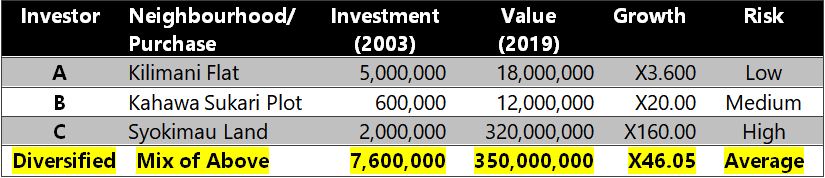
Sixteen years ago circa 2003, a friend offered to sell me a quarter acre of land in Kahawa Sukari, a suburb of Nairobi located in Kiambu County. Even though he was offering a substantial discount on the sale because he was a highly motivated seller, I passed on the opportunity because of some prejudicial thoughts I had at the time (my parents lived in the neighbourhood and I wasn’t inclined to live next door). The fair market value of the property at the time was actually KES 600,000. Today, that same parcel of land is selling at KES 12M. The market contrived to award those who made the investment with an X20+ growth.

Around the same time, a friend who was leaving the country to study abroad was faced with two investment prospects:

  1. Buy a new flat in the swanky Milimani neighbourhood of Riara by depositing KES 2M and taking a mortgage of KES 3M payable over 15 years; or
  2. Buy two 5-acre blocks of land at KES 1.8M in Syokimau, some nondescript place off Mombasa Road that was unknown at the time and then place the balance of her funds in some fixed deposit to earn interest or use the same balance to pay for the subdivision of the land into eighth-acre plots.

She made the seemingly less-popular of the two decisions electing to buy land in the “bundus”. Syokimau, a neighbourhood at the border between Nairobi and Machakos counties, was at the time just barren land with nothing notable to speak of on it. The property, as subdivided, would comfortably fetch a whopping KES 320M by 2019 market prices! That’s right. 320 million.

Comparing the three separate investors, these would have been the results:

Comparative analysis of land growth rates in three Nairobi suburbs.

Comparative analysis of land growth rates in three Nairobi suburbs.

In 2003, if you lived in Nairobi and wanted to live in a classy neighbourhood with all the cushy lifestyle trappings, Kahawa Sukari, would not have been on your radar. And certainly not Syokimau! They simply would not have made any apparent sense. None at all. Quite literally, Syokimau wasn’t even a neighbourhood at that time. Certainly not one on the minds of home buyers or property developers in the city. It was a desolate bush. Security would have been a concern. It was not the place to be. No roads. No shopping areas or malls. No schools. Nothing apparently progressive was happening yet.

Kahawa Sukari was just coming into its own. At least, it had some signs of development. It was rugged and coarse but there was some settlement. Between it and Syokimau (from a lifestyle perspective), Kahawa Sukari would have been preferable – several times over at least.

The Milimani suburbs on the other hand….now that was a happening place. New malls were sprouting (Prestige and The Junction had just come up around then). It had an extensive, well-maintained road network, all tarmacked. There were good schools, well-established homes. Hospitals within earshot. It was a mature neighbourhood even at the time. If you were looking for a superb address, there were already several here.

What takeaways can we then draw from this case study?

#1. The Safest “Investments” Aren’t Always the Most Lucrative

Of the three choices, while the decision to have acquired a flat in Kilimani may have made the most sense (especially to the “urbanites”) being that it carried the least risk, the result would have been the lowest capital gains (even if one could easily boast of owning property in one of Nairobi’s finest). And while the one that seemingly made the least sense and would have been viewed as the riskiest – Syokimau – was the only one that yielded incomparable gains, when pitted against the other two likely decisions.

Indeed, from this example, while the safest choices are “superficially” the most attractive; they are clearly the least financially attractive!

#2. Return on Investment Makes the World of Difference

A critical factor when comparing investment options is their trend of growth. It aids the investor to determine whether a neighbourhood is comparatively better to invest in than others. In this case, we will only compare the choice between Kahawa Sukari and Syokimau because they were relatively more comparable neighbourhoods at the time.

Compounded growth rate for two comparable suburbs of Nairobi.

Compounded growth rate for two comparable suburbs of Nairobi.

The sustained, annual growth for the period, while not markedly different (only 16%) produces a world of difference in the results. It is not applicable consistently over the initial years that an investment is held but can also be observed in the growth of development in the respective neighbourhoods. The annualized/compounded growth rate doesn’t follow a linear progression but instead follows a curved rate of growth.

#3. Diversification is Key To Managing Risk & Optimizing Results

Investors look to manage risk in such a way that maximizes returns. Another preferable approach may not necessarily be the maximization of returns but the optimization of results – diversifying investments to spread risk by seeking to secure the most optimal return on the full range of investment options available. Following this strategy, none of the three options above, taken exclusively on their own, is “the best”. The generally accepted rule for optimal returns is diversification which allows for aggregation of risk across investments with different rates of returns. Obviously, there is no way to know right at the point of investing which investments will perform well or poorly. The easiest way to explain this using the case study cited is as below:

Diversified portfolio with optimized investment results.

Diversified portfolio with optimized investment results.

This approach assumes that the investor has the capital or ability to invest in all the options available which would rarely be the case. Some investors also apply a weighted average method which puts higher volumes of capital to riskier classes of investments so that their average growth can be significantly higher. However, each individual investor has their own unique risk profile and it would be prudent to establish where your individual appetite for risk lies and match that to the specific investments you are willing to undertake.

In the case study, no investor lost money but their results were worlds apart. It cannot be discounted in the case study that some investors would be happy to merely own a home in an upmarket neighbourhood because of the security (low risk) it provides and will feel that an X4 growth is comfortable for them. It isn’t sufficient though. A good rule of thumb is to establish whether the rate of growth has allowed the investor to beat the cumulative growth in inflation over the period of time the investment has been held.

#4. Observing and Understanding the Market and Trends

The three neighbourhoods in the example above are fairly comparable. They’re all upper-middle-class neighbourhoods. All dominated by owner-occupied status (at least in 2003, Milimani was even though that seems to be changing now as more and more multi-dweller and commercial spaces are developed). They all had standards for controlled development. The trajectory of their growth is therefore bound to follow a similar path. For this reason, an investor could easily then observe similar markets and find opportunities in which the success of past investors is replicable.

The property values in these neighbourhoods grew to a large extent because of increased settlement (population growth), the expansion of road networks, public transport and other public infrastructure and services, improved access to mains services (water, electricity, sewerage), security and other basic amenities, improved access to public facilities and increased private investment (establishment of public administration offices, access to shopping areas, financial services, markets, health facilities, schools and so on).

While the growth is slow and only happens organically and is not always quickly discernible, investors with a keen eye will observe the trends and will see the opportunity portended in that growth. Over time, it is possible to discern patterns across different market segments, for instance between owner-occupied markets and renters markets; or between low-cost urban housing and upmarket housing. But it requires a disciplined level of commitment to follow the market and understand the trends through research.

#5. Create a Blueprint for Your Real Estate Investments

It’s OK to invest ad hoc. Investing works a lot better if you have an informed plan guiding your effort. There are ideas to be borrowed from the case study above. But it isn’t enough to attempt to replicate it.

Each individual might only be able to take up investments based on their own unique financial constraints, their incomes, expenditure and lifestyles; varying appetites for risk, emotional and situational needs, tastes and preferences.

These factors necessitate that investors’ map out their own investment blueprints with clear goals; an entry and exit plan. Gregarious strategies (herding) are great but they often fail because of a lack of congruence in individuals’ ideals, philosophy and expectations. Many of us plan around others in order to “keep up” or find acceptance in particular social circles. Maintaining focus on our goals is best achieved when they are documented and planned for so that even in the face of emotional turbulence and market uncertainty we don’t lose track. A blueprint is desirable in helping us identify our individual path to reaching our goals; achieving peace of mind and attaining financial freedom.

#6. Be Bold. Be an Outlier.

None but the brave deserve the fair. That may be an expression you’ve heard. It is nowhere more true that in the world of real estate investing. Conventional thinking will only get you so far. And calculated risk needn’t be overthought, just calculated. To get phenomenal, you’re going to have to make some bold moves and do some fringe thinking.

It is the outliers who make change happen. They go in early. Lead from the front. Swim against the tide. Reap big!

If you’re driven by the fear of missing out, you’re already going on convention and merely riding the crest of all the wrong emotions that should spur investment decisions. Discipline. Counsel. Research. These are the attitudes and practices of winners!

content

Unpacking Property Scams & The Red Flags Around Them

Property Scams cause untold financial distress and economic turmoil. The memories of the experience don’t leave quickly and can haunt their victims. I’ve been down that road, I know. In 2016, one such scam which purportedly gave investors the fast-track to homeownership decimated hundreds of millions in investors savings and credit. With no discernible repertoire of property developments, one would imagine that the scam would have been unearthed quickly, or that victims would have shied away. Yet, despite the alarm bells sounded against this property scam, would-be investors still piled in on an unprecedented scale. This fraud wasn’t just an indictment on the state of investor awareness and culture in this market, but also on market regulation, consumer protection mechanisms and investor education.

If we could remove the property scam artists out of the equation for just a second, just what renders seemingly rational individuals to become predisposed to the wiles of scammers? Is it a strong desire to achieve their goals? Is it their naivety or perhaps a misguided belief in overnight wealth and success? Is it their readiness to believe in get-rich-quick schemes or their failure to understand how things actually work? Who wouldn’t embrace the possibility of financial freedom if presented with an opportunity to get rich overnight, however incredulous? What if that opportunity required negligible effort, who wouldn’t that appeal to? Faced with the prospects offered by the property scam artist, do victims know what questions they should ask?

What Do Property Scams Look Like?

Property scams, like ghosts, assume whatever form imaginable by those who conjure them. If only scammers warned their pawns ahead of time, right? Whatever form they assume, they all tend to have a common feature – there is usually something unbelievable or untenable about them, a red flag or a series of red flags. Of course, the very reason victims get sucked into scammers’ orbit is that those qualities are quite magical, even hypnotic. These red flags, or bait, are what the scammer uses to lure victims. Like green snakes in the grass, they are particularly insidious because they are hidden in plain sight and unless one knows what to look for, they’re not likely to be attentive enough to see them.

Even more daunting is that as they run their course, property scams often morph and mutate, becoming increasingly complex and agile in their nature so that by the time the trap is sprung, the scammer has had sufficient time to conceal their intent, erase their footprint and potentially vanish into thin air – all while their unsuspecting victims still believe that all is well.

It’s easier to fool people than to convince them that they’ve been fooled

Most scams go unreported because their victims invariably get embarrassed and don’t want to be shamed in public. Scams that attract the media spotlight usually only do so because of the creativity, flair and scale on which they are committed. Scams ordinarily present as legitimate market offers eventually mutating to fit in with their perpetrators’ goals so there is little in the way of preemptive measures to avoid them because they are invariably unearthed post-mortem. Scammers don’t operate with any deference to market regulation so it also unlikely that market protections would serve any purpose to preempt their perpetration.

Where Shall Help Come From?

So, if scammers are able to conceal their intent, and market protection mechanisms only kick in retroactively, is there a silver bullet or magic potion to inoculate would-be victims from the wiles of scammers who would happily steal their future in the property market? Sadly, there is neither one nor the other. However, you can get ahead of scammers by understanding how to identify the red flags around scams, the elements of your nature that they tend to exploit, and what those who conjure them into existence engineer into their traps.

Property Scams: The Scammers Guide

Have you ever observed a moth around a lit candle? If you have, you will understand, at least theoretically, how scams are built and pulled off. The candle emits a glow which offers warmth to the moth so that even the poor creature’s instincts are numbed to the allure of an open flame. In a near-cataleptic state, the moth begins to dance around the flame, repeatedly having his wings singed to the point where he loses the ability to fly. There is a lesson from the moth that needs to be learned. Bright, shiny things can bring death! Look away from the light! One would imagine that having been burnt once, or twice even, the darn thing would just flee the scene. But no. He keeps going in.

Hope Springs Eternal!

Hypnosis trumps instinct! Scammers know this. So they will build a mesmerizingly bright light into their “death traps” – it warms your spirit (gives you hope or fuels your greed?) and hypnotizes you. Just like the moth, you cannot flee; you surrender yourself to be courted.  

To different people the allure is different but it is invariably manifested in more money or prestige or by some other thing desired by the scammer’s victims – something for which you will give up all. Forget love, or sex, or drugs, this thing is much more potent! Once a scammer discovers that thing, he just needs to lie in wait.

Where Are Your Wits?

Of course, for you to realize that the game is afoot, you must keep your wits (instinct) about you. The moth loses his wings because the warmth from the candle renders him comatose, just as the investor loses his ability to analyze risk or make rational decisions immediately greed wins him over.

  1. Be Skeptical. You won’t see the red flags if you’re not looking for them.
  2. Market Savvy: You wouldn’t know what is unbelievable or unreasonable if you don’t know what is believable or reasonable. If something about what is being sold to you sounds unbelievable/ too-good-to-be-true (that light that’s about to clip your wings dear moth), test it, understand how it works, research, get professional help…do all you can to get to the truth before you jump in headlong and straight into the concrete.
  3. Do the math. Does it add up?
  4. Are you under pressure to sign up? You may want to step back and have another look.

In any market, investment opportunities that turn exceptional returns are classified “high-risk, high-return” ventures. The prospect of investing in such an opportunity should be met with a clear effort at analyzing and understanding risk, developing mitigation strategies and exit plans.

Property Scams: The Red Flags

Scammers will always incentivize their prospects with a variety of “good things”. Enticements may be couched in something that is seemingly free, or as a shortcut to achieving something desired –a panacea for all your troubles and ills. So what are the red flags?

#1. Shortcuts To Get You There Faster

You will be remiss to believe that investment processes can be circumvented. Perhaps there may be some more efficient ways to achieve tasks or goals but the process must be followed. Scammers use the promise of getting you there faster to lure you in. Who doesn’t want to get anywhere faster? Even better, who doesn’t want to get there faster than everyone else?

#2. So Easy To Do

Faced with a daunting task, we are inherently wired to take the lazy route and so the easiest way to get anyone to sign up for anything is to sell it as easy-to-do, easy-to-sign-up, no-work-required-on-your-part. Scammers know that we all want to get away with something for nothing if we can and they will use this against you!

#3. Secrets of the Rich & Famous

Ever seen the videos that offer to whisper the secrets of the rich and famous directly into your ear? The easiest way for a scammer to sear themselves into your heart and mind is to offer something highly desired but seemingly elusive. Most people won’t see through the promise except their belief in it.

#4. Get a Free Ride Here

If someone promised you a product that would deliver your dream of home ownership at zero-interest finance cost, in market conditions of a growing housing deficit and where the traditional lenders financing the same product at 15% were servicing fewer than 25000 customers, would you buy the product? There’s clearly an appeal (as pleasant perhaps as the warmth of an open flame to the moth) but does the product come across as tenable or even believable? This scam was pulled off successfully in our market fewer than two years ago. Even though there was no frame of reference to evaluate the opportunity, many of the victims were more willing to believe in the opportunity rather than in the incredulity of it.

#5. High-Pressure Sales Tactics

After a free lunch, you are more amenable to hear what your benefactor has to say. A quick, flashy presentation and thereafter all the stops are pulled out to get you to sign-up. Amazing offers (just for today). You will be cajoled, courted, prodded and every imaginable trick used to get you to sign on the dotted line. Representatives will be sent to smooth things over with you. Need a payment plan, there is one! The reason the property scam artists don’t want you mulling too long over the snake-oil they are peddling is that they know the voice of reason may prevail when you’re left to your thoughts.

#6. It’s All In-House

One clear sign that you’re about to swim down the river without a life-jacket is the promise that everything you need is under one roof. The allure is obviously the convenience that seems to come with the product you’re buying. For property scams, this may take the form of the scammer having in-house professionals rolled into the framework of the scam to include say property developers, legal and even financial experts. Because of the interests of the scammer and those of their pawns are at conflict, these experts are just a ruse. There is an unholy alliance here, one which will only rear its ugly head when the truth begins to out.

#7. We Do It, Even When We Don’t Do It

You need to ascertain the true nature of the business of anyone selling you a product in the property market. What would qualify a property seller, for instance, to guarantee you a return on an agribusiness venture? If you paused to think about it, none at all! You may realize that the property seller who includes greenhouses and the prospect of a return on the associated agri-business venture connected to the offer for land he is selling you, has just crafted an ingenious gimmick to move the property he is selling and has already priced the cost of the greenhouses into the cost of his product. This scam is still practiced in our market even today. But don’t take my word for it. Look for those who bought into these schemes and let them tell you their experiences.

#8. The Hysteria of the Masses:

Once a critical mass of people believes a scammer’s lie, it starts to breed as if by binary fission, like a single-celled creature infecting the market with its insidiousness. Think about this: If five people within your circle start to talk about five people within their respective circles doing something “life-changing” that’s trendy or new and has been presented as an amazing opportunity, aren’t you going to sit up and listen? The very human fear of missing out spurs interest so that soon enough, you’ll be the sixth person speaking to six other people who will do the same thing and before long the body of victims starts to pile on organically. The lie takes on a life of its own becoming an uncontrollable beast and sucking in more and more victims until the moment of truth arrives!

Property Scams: The Scammers Toolkit

#1. What Scammers Look Like

Property scam artists possess many intuitive qualities that situate them perfectly to exploit human capacity for greed. They are excellent at rapport-building and can make even strangers feel familiar and accepted. They are consummate actors, masters of detail, attentive listeners and often the most meticulous, well-researched individuals in the room. They endear themselves through an unrivaled understanding of the dreams and aspirations of their pawns, by displaying intense sensitivity and camaraderie. They can think on their feet, refining their plans on a whim all while building an aura of superiority and authority to consolidate the trust placed in them. They are well articulated, and both highly persuasive and deceptive in equal measure and apply any means necessary to propel their agenda.

# 2. Weaponizing Trust, Desperation, Greed and Ignorance

Property scam artists have the ability to weaponize human nature in furtherance of their goals. The right combination of trust, desperation, greed, ignorance and the fear of missing out is their hunting grounds because when we want to believe something to be true, we become susceptible to the suggestion that it can be. The desire to keep up with or outpace others in the race of life compounds the fear of missing out. The key to this recipe, however, is human capacity for greed!

#3. All Human Beings Are Good and Kind

We want to believe in the goodness and kindness of others because we may see ourselves that way and because doing good feels good. We falsely believe we can somehow spot malevolence and connivance in others.  These pseudo-beliefs build the scene for scammers to build our confidence. These beliefs are so strong that even presented with evidence or facts to the contrary, most victims’ default position will usually be that all is well.  We refuse to see what we don’t want to see, especially when it doesn’t fit well with the picture we’ve constructed in our minds. The rational thing we would ordinarily do before committing resources to investments is to objectively evaluate them and any alternative options. Blind trust and/or ignorance, greed and our desperation to believe in outrageous possibilities that a scammer may be peddling, even when questionable, often outstrip rational behaviour or response. So we abandon all investigation or the critical analysis that would help us see through the scammer’s deceit.

#4. Everyone is Fair Game

A scammer, well-versed in their “craft” understands that victims are easily found among individuals who have recently undergone some sort of profound change or experience. People who are vulnerable to scams are not necessarily desperate or ignorant (usually just greedy or well-meaning). Profound change can create instability whether positive or negative.  Hypothetically, an individual who just won millions in a lottery is just as susceptible (if not more) to being scammed as an individual who just lost his job. Both events, one seemingly positive and the other negative, create susceptibility that can be exploited.

Conclusion

Identifying scams isn’t a clear-cut task. But with a clearer idea of how they are presented, how property scam artists work, and importantly, the elements of human nature that make victims most susceptible to getting conned, you have the tools to avoid them. The heart may want what it wants and perhaps that’s why we have heads. Now you know. Don’t let them steal your dreams.

Vacant Land in Kenya: What You Should Know Before Buying

  • Why Vacant Land Remains a Popular Investment in Kenya

  • Understanding the Value Proposition of Vacant Land

  • The Role of Vacant Land in Wealth Creation Strategies

  • Investing in Vacant Land for Cashflow vs Capital Gains

  • New Investment Frontiers for Vacant Land in Kenya

  • Using Data to Guide Vacant Land Investment Decisions

  • Final Thoughts on Land Banking and Vacant Land Strategy

Understanding the Popularity of Vacant Land

Vacant land is more than just an empty plot—it is one of Kenya’s most popular property investment options. Beyond its traditional agricultural use, vacant land has emerged as a strategic asset for residential and commercial development.

In terms of market performance, vacant land consistently outpaces other real estate products, particularly due to its mass appeal and affordability.

SACCOs, Chamas, and pension schemes dominate the vacant land acquisition and sales market, often targeting employees and first-time investors.

Their bulk purchasing and subdivision strategies make vacant land accessible across economic classes.

But just why are vacant land sales so popular? Here are some reasons:

Divisibility and Affordability of Vacant Land

One major reason for the appeal of vacant land is its divisibility and affordability. Land selling companies often buy large parcels, subdivide them, and offer smaller, more affordable plots to the open market. From KES 20,000 to over KES 200 million, there’s an opportunity available for nearly every budget.

Cultural, Historical Significance and Social Pressure

Vacant land is culturally celebrated. From early adulthood, Kenyans are advised to acquire a plot, marking it as a rite of passage into maturity and financial responsibility. Social circles often equate land ownership with progress, and many feel pressure to join the ranks of landowners to gain respect and status.

Why Vacant Land Appeals to Different Types of Investors

The Capital Gains Seeker

A major draw of vacant land is the potential for capital gains. With no need for post-acquisition improvement, investors simply buy and wait for the value to increase. Due to population growth and expanding settlements, this strategy often delivers solid returns.

The Cash Flow Investor

Some investors pursue cash flows by using vacant land for income-generating activities. Depending on location and size, options may include:

  • Agricultural ventures
  • Leasing for commercial use
  • Joint ventures for development
  • Multi-unit housing projects

The Saver-as-Investor Profile

Many investors buy into the opportunity not for development or cash flow, but to “store” their money. They may plan to develop it later or simply enjoy watching their asset appreciate. While not the most productive use, this passive strategy remains common.

Investing in Vacant Land: Key Considerations

Establishing Investment Objectives

Before acquiring vacant land, investors must clarify their goals. Is it for appreciation, cash flow, or a future personal project? Without defined objectives, buying land can become a misguided allocation of resources.

The Risk of Illiquidity

It is an illiquid asset. It can be challenging to resell quickly, especially in soft markets. Investors should assess how long they can wait before liquidating their assets and whether those assets fit within their broader financial strategy.

Without a clear underlying investment objective, the amassing of vacant land acquisitions can be misguided and may not be the best application of resources simply because land is an illiquid asset.

New Frontiers: Emerging Opportunities in Vacant Land

Factors Driving Land Value Growth

Kenya’s vacant land market is driven crucially by three key factors:

  • Population growth
  • Infrastructure development
  • Expansion of human settlements

Areas once considered rural are now hotspots for capital gains and settlement due to road expansions, new transport corridors, and devolution of government functions to the counties, alongside expanded infrastructure projects.

Using Data to Make Informed Decisions

To spot opportunities, investors should study historical performance, government development plans, and demographic trends. Resources like:

…offer invaluable insights into where land values may rise next.

Nairobi and Surrounding Counties: A Case in Point

Projects like the Nairobi Metropolitan Services Improvement Project and the Nairobi Integrated Urban Development Master Plan (NIUPLAN) will greatly influence the value of vacant land around Nairobi. These projects include:

  • Transport upgrades (urban roads, railway, airports)
  • Water and sanitation improvements
  • Solid waste management infrastructure

The County Government of Nairobi has since created the Nairobi City County Integrated Development Plan for 2023 -2027, which documents the development plans for Nairobi County of the five year period covered by the plan.

This County Development Plan shows the different development priority areas for a variety of infrastructure within the city and its surroundings in the areas of urban transport, energy, water supply, sewerage, telecommunication and solid waste management.

All these developments will impact the real estate market within the county and its environs.

In addition to these projects, there are massive undertakings at both the national and county levels, which are bound to create investment opportunities in the real estate market, both in the short and long term. The Affordable Housing Program, for example, while exclusively a government project, will expand housing, creating new commercial opportunities.

The expanded mandates for devolved government units at county level complemented by the rapid expansion of road networks, the adoption of new mass commuter transport systems and the ongoing development of new national transport corridors including LAPSSET, as well as other infrastructure projects all over the country will profoundly shape the country’s real estate market over the next few years.

Beyond Speculation: Smarter Approaches to Vacant Land

Avoiding the Land Banking Trap

While land banking can yield high returns, it’s often speculative and relies on the behaviour of other investors. The risk is amplified when the investor lacks direct control or legal ownership. Investing directly in vacant land provides greater autonomy and clearer legal safeguards.

Creating, Not Just Consuming, Opportunities

Instead of merely subscribing to land-banking schemes, investors should explore becoming vendors or initiating their own subdivision projects. This proactive approach can yield better returns and control over the investment outcome.

Final Thoughts on Vacant Land Investment in Kenya

The acquisition of small-holder plots will continue to be an attractive proposition in Kenya’s real estate market into the foreseeable future. In particular, selling plots to be acquired for “speculative investments” will not lose its appeal any time soon.

You can optimise investments of this nature if you are guided by clear goals, sound data, and an awareness of the market and the risks therein. This will allow you to tap into the potential of vacant land acquisitions to generate capital gains or even immediate cash flow. How you invest in vacant land will determine your ability to unlock this powerful wealth-building tool.