Buyer Agency Explained: Why It’s a Game-Changer for Kenyan Property Buyers

  • What Is Buyer Agency and Why It Matters

  • How Buyer Agency Works in Kenya

  • Benefits of Buyer Agency in Kenya

  • Common Misconceptions About Buyer Agency

  • When Buyer Agency Is Most Valuable

  • Choosing the Right Buyer Agent

  • Enhanced Buyer Agency—Adding Value Beyond the Basics

  • Final Thoughts on Buyer Agency

Navigating Kenya’s real estate market can be complex, and that’s where Buyer Agency shows its true value.

In Kenya, the real estate market has traditionally been oriented towards sellers, creating the widely held presumption that property agents primarily represent sellers in the market.

Buyer agency is almost a myth.

With dedicated representation, buyer agents help you find the right property, negotiate better terms, and safeguard your interests from start to finish.

Let’s explore how partnering with a buyer agent can deliver smarter, more efficient property transactions.

What Is Buyer Agency and Why Does It Matter

Defining Buyer Agency

Buyer Agency is a professional arrangement where the agent represents you, the buyer, not the seller. This ensures loyalty to your interests through the entire transaction.

Core Responsibilities of a Buyer Agent

  • Identifying properties matching your criteria
  • Conducting market research and due diligence
  • Guiding you on pricing and negotiation
  • Coordinating inspections, paperwork, and legal support
Fewer hassles in managing the due diligence, documentation, transfer and registration processes. Reduced time between the identification of properties matching your requirements and closing. Less money paid on the capital cost(s) of the transaction. Fewer mistakes and a guaranteed best-value deal.

Buyer agency allows buyers to leverage the superior industry knowledge, connections and networks of property agents who are better placed to secure you the best deal possible.

Against the possibility of expensive mistakes, the decision to go the buyer agency route may also be justified.

How Buyer Agency Works in Kenya

The Buyer Agency Agreement

This formal contract outlines:

  • Scope and duration of representation

  • Fee structure—who pays and how much

  • Conflict-of-interest policies and confidentiality clauses

Exclusive vs Non-Exclusive Buyer Agency

  • Exclusive: The agent works solely for you, never for the seller

  • Non-Exclusive: You retain the flexibility to work with multiple agents

Advantages of Exclusive Agency

With exclusivity, your agent’s loyalty is guaranteed, increasing their motivation to leverage networks and time to find the right deal for you.

Benefits of Buyer Agency in Kenya

Access to Off-Market Properties

Buyer agents uncover hidden deals through their network, giving you a first look at unlisted properties.

Expert Negotiation on Your Behalf

With in-depth data and market insight, agents negotiate on price, closing terms, and even seller concessions to your advantage.

Streamlined and Professional Process

From inspections to legal review, a buyer agent ensures smooth coordination, saving you time and stress. 

Common Misconceptions About Buyer Agency

“Buyer Agents Are Too Expensive”

While there’s a fee, buyer agents often save you more than they cost by avoiding hidden issues and negotiating better deals. Gathering, understanding and assimilating market information necessary to make the best-informed decision can be a tall order.

The buyer’s agent is better-placed to do this; helping you to analyze offers on the basis of comparables and market trends; using their market intelligence built-up over time to find you bargain offers – not just the ones that may be in their repertoire of offers – that will save you money, using their intimate knowledge and networks to help reduce the hassles, stress and time between searches and the likely hurdles that will be encountered along the path to completion of registration of the transfers.

“I Can Do It Myself”

Without expert support, buyers can overpay, miss key risks, or struggle with complex legal steps. A buyer agent provides protection and clarity.

Real estate transactions are an emotional affair that can induce panic, fretfulness and exhilaration all at once. It is understandable that these emotions will show up because of the money involved. A sober, clear mind can be helpful.

When Buyer Agency Is Most Valuable

Ideal for First-Time Buyers

If you’re new to property buying or unfamiliar with legal processes, buyer agency is a valuable guide.

Essential for Investors and High-Value Buyers

For multiple or high-value property purchases, strategic representation helps optimise your portfolio.

Unlocking Off-Market Opportunities

Agents with strong networks can reveal exclusive listings before they hit the public market.

Buyers agents don’t just search for comparable offers that match your requirements, they seek to find bargain offers providing you with you greater value.

In addition, they will negotiate the most favourable price and terms and make sure that all pertinent documentation and disclosures are handled at the appropriate stages of the transaction.

Industry knowledge can be critical to the buyer for conveyancing advocates, financing (securing mortgages), property valuations, insurance, and all other relevant matters from acceptance to close. 

Choosing the Right Buyer Agent

Important Vetting Questions

  • Do you represent only buyers?
  • Can you share past negotiation examples and savings?
  • What is your fee structure and contract term?
  • Are you experienced in our target locations and property types?

Red Flags to Observe

  • Dual representation of buyers and sellers
  • No clear written agreement or fee transparency
  • Limited local market knowledge or lack of proven track record.

Enhanced Buyer Agency—Adding Value Beyond the Basics

Data-Driven Market Insight

Top buyer agents review comparables, title histories, and valuation reports to guide your offers.

Legal & Due Diligence Support

Rather than navigating legal disclosures alone, your agent connects you with trusted lawyers and helps interpret key documents.

Customised Deal Structuring

Know your financing—from cash, mortgage, or instalment—agents ensure your offer aligns with your financial profile and lender terms.

Conclusion: Final Insights on Buyer Agency

When you partner with a Buyer Agency, you gain more than access to listings—you gain a strategic advocate. In Kenya’s fast-paced and often opaque property market, this representation can be the difference between overpaying and securing your dream home at fair value.

How To Secure Phenomenal Capital Growth In The Property Market

Ever wish you had one of those magical crystal balls that would help you see deep into the future? Or perhaps, like in one of those fast-motion camera sequences, a video that could magically transport you across a long timeline in just a matter of seconds revealing just how things will unravel, say ten to fifteen years into the future? I feel you! I wish I did too. I don’t know what you’d use yours for, perhaps find yourself that elusive knight in shining armour, or buy the winning numbers to secure a tidy windfall in a lottery or betting scheme. I’d probably use mine to do a little more. Like to anticipate markets so that I could create me some generational wealth! OK, I’m indulging in some wishful thinking here, but you get the point! Except for a magical crystal ball, how else can you actually foresee where the markets are going; where the opportunities are to actually secure phenomenal capital growth in the property market?

One of the fundamental premises of investing in real estate, indeed investing in any asset class, is obviously the opportunity to secure capital gains– the appreciation of capital that often happens over the time an asset is held. Sure there are other goals for which investments are made, like the emotional security they provide. However, it is important to understand that all other goals for investing derive from the financial security they create.

Secure Phenomenal Capital Growth in the Property Market

For almost thirty years (between 1985 and 2014), capital gains on real estate and other investments in Kenya were untaxed. This gave investors the opportunity to create substantial wealth from investments in real estate and such other qualifying investments. The overall bullish market trend over that period of time in both urban centres and emerging towns allowed many investors to profit handsomely from their real estate investments; securing generational wealth that they could comfortably retire on and even pass on to their families.

So how exactly did they do it? Were they merely speculative in their approach, or possibly just lucky? For those that did it with great success, were the methods they used replicable?

Is Capital Growth Assured?

It is generally considered in this market that capital growth is assured if you hold an asset long enough. But is it sufficient to simply acquire property, even speculatively, because of this presumption? That same presumption has ensured that the “plot” culture in this country is firmly rooted. Like the social pressure that everyone the unmarried over 25 who must be familiar with, every gainfully-employed or otherwise productive individual in Kenya is at some point expected, by the standards and norms of this nation, to at the very least own a plot (or even plots); at the bare minimum, that spit of land commonly referred to as an eighth (a.k.a. 50 by 100). Otherwise, you are just good for being ridiculed.

Aware of this, land sellers have capitalized on pushing plots at exorbitant prices to herding, lazy investors. And they’re all in on the game; the cooperative SACCOs we all faithful save up with, property developers and even the wildly popular “chamas“.

Even though most vacant land buyers might not be able to afford to build homes on their acquisitions, the tendency is to perpetually confine those acquisitions to their “rainy-day” funds because they are presumed to appreciate. The mere possibility of marginal growth and the security associated with those assets may not be sufficient.

Understandably, part of the vacant land culture is based on the valid, yet elusive dream of home ownership. But alas, the question is, how can you make phenomenal capital gains; not just good capital gains, but phenomenal gains?

Case Study: A Tale of Three Nairobi Suburbs

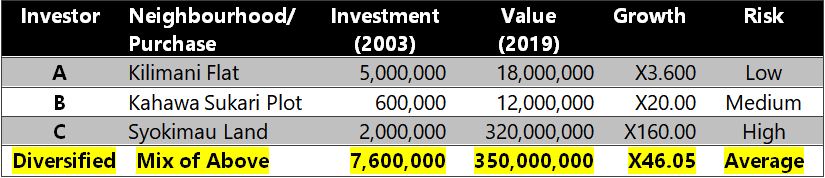
Sixteen years ago circa 2003, a friend offered to sell me a quarter acre of land in Kahawa Sukari, a suburb of Nairobi located in Kiambu County. Even though he was offering a substantial discount on the sale because he was a highly motivated seller, I passed on the opportunity because of some prejudicial thoughts I had at the time (my parents lived in the neighbourhood and I wasn’t inclined to live next door). The fair market value of the property at the time was actually KES 600,000. Today, that same parcel of land is selling at KES 12M. The market contrived to award those who made the investment with an X20+ growth.

Around the same time, a friend who was leaving the country to study abroad was faced with two investment prospects:

  1. Buy a new flat in the swanky Milimani neighbourhood of Riara by depositing KES 2M and taking a mortgage of KES 3M payable over 15 years; or
  2. Buy two 5-acre blocks of land at KES 1.8M in Syokimau, some nondescript place off Mombasa Road that was unknown at the time and then place the balance of her funds in some fixed deposit to earn interest or use the same balance to pay for the subdivision of the land into eighth-acre plots.

She made the seemingly less-popular of the two decisions electing to buy land in the “bundus”. Syokimau, a neighbourhood at the border between Nairobi and Machakos counties, was at the time just barren land with nothing notable to speak of on it. The property, as subdivided, would comfortably fetch a whopping KES 320M by 2019 market prices! That’s right. 320 million.

Comparing the three separate investors, these would have been the results:

Comparative analysis of land growth rates in three Nairobi suburbs.

Comparative analysis of land growth rates in three Nairobi suburbs.

In 2003, if you lived in Nairobi and wanted to live in a classy neighbourhood with all the cushy lifestyle trappings, Kahawa Sukari, would not have been on your radar. And certainly not Syokimau! They simply would not have made any apparent sense. None at all. Quite literally, Syokimau wasn’t even a neighbourhood at that time. Certainly not one on the minds of home buyers or property developers in the city. It was a desolate bush. Security would have been a concern. It was not the place to be. No roads. No shopping areas or malls. No schools. Nothing apparently progressive was happening yet.

Kahawa Sukari was just coming into its own. At least, it had some signs of development. It was rugged and coarse but there was some settlement. Between it and Syokimau (from a lifestyle perspective), Kahawa Sukari would have been preferable – several times over at least.

The Milimani suburbs on the other hand….now that was a happening place. New malls were sprouting (Prestige and The Junction had just come up around then). It had an extensive, well-maintained road network, all tarmacked. There were good schools, well-established homes. Hospitals within earshot. It was a mature neighbourhood even at the time. If you were looking for a superb address, there were already several here.

What takeaways can we then draw from this case study?

#1. The Safest “Investments” Aren’t Always the Most Lucrative

Of the three choices, while the decision to have acquired a flat in Kilimani may have made the most sense (especially to the “urbanites”) being that it carried the least risk, the result would have been the lowest capital gains (even if one could easily boast of owning property in one of Nairobi’s finest). And while the one that seemingly made the least sense and would have been viewed as the riskiest – Syokimau – was the only one that yielded incomparable gains, when pitted against the other two likely decisions.

Indeed, from this example, while the safest choices are “superficially” the most attractive; they are clearly the least financially attractive!

#2. Return on Investment Makes the World of Difference

A critical factor when comparing investment options is their trend of growth. It aids the investor to determine whether a neighbourhood is comparatively better to invest in than others. In this case, we will only compare the choice between Kahawa Sukari and Syokimau because they were relatively more comparable neighbourhoods at the time.

Compounded growth rate for two comparable suburbs of Nairobi.

Compounded growth rate for two comparable suburbs of Nairobi.

The sustained, annual growth for the period, while not markedly different (only 16%) produces a world of difference in the results. It is not applicable consistently over the initial years that an investment is held but can also be observed in the growth of development in the respective neighbourhoods. The annualized/compounded growth rate doesn’t follow a linear progression but instead follows a curved rate of growth.

#3. Diversification is Key To Managing Risk & Optimizing Results

Investors look to manage risk in such a way that maximizes returns. Another preferable approach may not necessarily be the maximization of returns but the optimization of results – diversifying investments to spread risk by seeking to secure the most optimal return on the full range of investment options available. Following this strategy, none of the three options above, taken exclusively on their own, is “the best”. The generally accepted rule for optimal returns is diversification which allows for aggregation of risk across investments with different rates of returns. Obviously, there is no way to know right at the point of investing which investments will perform well or poorly. The easiest way to explain this using the case study cited is as below:

Diversified portfolio with optimized investment results.

Diversified portfolio with optimized investment results.

This approach assumes that the investor has the capital or ability to invest in all the options available which would rarely be the case. Some investors also apply a weighted average method which puts higher volumes of capital to riskier classes of investments so that their average growth can be significantly higher. However, each individual investor has their own unique risk profile and it would be prudent to establish where your individual appetite for risk lies and match that to the specific investments you are willing to undertake.

In the case study, no investor lost money but their results were worlds apart. It cannot be discounted in the case study that some investors would be happy to merely own a home in an upmarket neighbourhood because of the security (low risk) it provides and will feel that an X4 growth is comfortable for them. It isn’t sufficient though. A good rule of thumb is to establish whether the rate of growth has allowed the investor to beat the cumulative growth in inflation over the period of time the investment has been held.

#4. Observing and Understanding the Market and Trends

The three neighbourhoods in the example above are fairly comparable. They’re all upper-middle-class neighbourhoods. All dominated by owner-occupied status (at least in 2003, Milimani was even though that seems to be changing now as more and more multi-dweller and commercial spaces are developed). They all had standards for controlled development. The trajectory of their growth is therefore bound to follow a similar path. For this reason, an investor could easily then observe similar markets and find opportunities in which the success of past investors is replicable.

The property values in these neighbourhoods grew to a large extent because of increased settlement (population growth), the expansion of road networks, public transport and other public infrastructure and services, improved access to mains services (water, electricity, sewerage), security and other basic amenities, improved access to public facilities and increased private investment (establishment of public administration offices, access to shopping areas, financial services, markets, health facilities, schools and so on).

While the growth is slow and only happens organically and is not always quickly discernible, investors with a keen eye will observe the trends and will see the opportunity portended in that growth. Over time, it is possible to discern patterns across different market segments, for instance between owner-occupied markets and renters markets; or between low-cost urban housing and upmarket housing. But it requires a disciplined level of commitment to follow the market and understand the trends through research.

#5. Create a Blueprint for Your Real Estate Investments

It’s OK to invest ad hoc. Investing works a lot better if you have an informed plan guiding your effort. There are ideas to be borrowed from the case study above. But it isn’t enough to attempt to replicate it.

Each individual might only be able to take up investments based on their own unique financial constraints, their incomes, expenditure and lifestyles; varying appetites for risk, emotional and situational needs, tastes and preferences.

These factors necessitate that investors’ map out their own investment blueprints with clear goals; an entry and exit plan. Gregarious strategies (herding) are great but they often fail because of a lack of congruence in individuals’ ideals, philosophy and expectations. Many of us plan around others in order to “keep up” or find acceptance in particular social circles. Maintaining focus on our goals is best achieved when they are documented and planned for so that even in the face of emotional turbulence and market uncertainty we don’t lose track. A blueprint is desirable in helping us identify our individual path to reaching our goals; achieving peace of mind and attaining financial freedom.

#6. Be Bold. Be an Outlier.

None but the brave deserve the fair. That may be an expression you’ve heard. It is nowhere more true that in the world of real estate investing. Conventional thinking will only get you so far. And calculated risk needn’t be overthought, just calculated. To get phenomenal, you’re going to have to make some bold moves and do some fringe thinking.

It is the outliers who make change happen. They go in early. Lead from the front. Swim against the tide. Reap big!

If you’re driven by the fear of missing out, you’re already going on convention and merely riding the crest of all the wrong emotions that should spur investment decisions. Discipline. Counsel. Research. These are the attitudes and practices of winners!

content

Unpacking Property Scams & The Red Flags Around Them

Property Scams cause untold financial distress and economic turmoil. The memories of the experience don’t leave quickly and can haunt their victims. I’ve been down that road, I know. In 2016, one such scam which purportedly gave investors the fast-track to homeownership decimated hundreds of millions in investors savings and credit. With no discernible repertoire of property developments, one would imagine that the scam would have been unearthed quickly, or that victims would have shied away. Yet, despite the alarm bells sounded against this property scam, would-be investors still piled in on an unprecedented scale. This fraud wasn’t just an indictment on the state of investor awareness and culture in this market, but also on market regulation, consumer protection mechanisms and investor education.

If we could remove the property scam artists out of the equation for just a second, just what renders seemingly rational individuals to become predisposed to the wiles of scammers? Is it a strong desire to achieve their goals? Is it their naivety or perhaps a misguided belief in overnight wealth and success? Is it their readiness to believe in get-rich-quick schemes or their failure to understand how things actually work? Who wouldn’t embrace the possibility of financial freedom if presented with an opportunity to get rich overnight, however incredulous? What if that opportunity required negligible effort, who wouldn’t that appeal to? Faced with the prospects offered by the property scam artist, do victims know what questions they should ask?

What Do Property Scams Look Like?

Property scams, like ghosts, assume whatever form imaginable by those who conjure them. If only scammers warned their pawns ahead of time, right? Whatever form they assume, they all tend to have a common feature – there is usually something unbelievable or untenable about them, a red flag or a series of red flags. Of course, the very reason victims get sucked into scammers’ orbit is that those qualities are quite magical, even hypnotic. These red flags, or bait, are what the scammer uses to lure victims. Like green snakes in the grass, they are particularly insidious because they are hidden in plain sight and unless one knows what to look for, they’re not likely to be attentive enough to see them.

Even more daunting is that as they run their course, property scams often morph and mutate, becoming increasingly complex and agile in their nature so that by the time the trap is sprung, the scammer has had sufficient time to conceal their intent, erase their footprint and potentially vanish into thin air – all while their unsuspecting victims still believe that all is well.

It’s easier to fool people than to convince them that they’ve been fooled

Most scams go unreported because their victims invariably get embarrassed and don’t want to be shamed in public. Scams that attract the media spotlight usually only do so because of the creativity, flair and scale on which they are committed. Scams ordinarily present as legitimate market offers eventually mutating to fit in with their perpetrators’ goals so there is little in the way of preemptive measures to avoid them because they are invariably unearthed post-mortem. Scammers don’t operate with any deference to market regulation so it also unlikely that market protections would serve any purpose to preempt their perpetration.

Where Shall Help Come From?

So, if scammers are able to conceal their intent, and market protection mechanisms only kick in retroactively, is there a silver bullet or magic potion to inoculate would-be victims from the wiles of scammers who would happily steal their future in the property market? Sadly, there is neither one nor the other. However, you can get ahead of scammers by understanding how to identify the red flags around scams, the elements of your nature that they tend to exploit, and what those who conjure them into existence engineer into their traps.

Property Scams: The Scammers Guide

Have you ever observed a moth around a lit candle? If you have, you will understand, at least theoretically, how scams are built and pulled off. The candle emits a glow which offers warmth to the moth so that even the poor creature’s instincts are numbed to the allure of an open flame. In a near-cataleptic state, the moth begins to dance around the flame, repeatedly having his wings singed to the point where he loses the ability to fly. There is a lesson from the moth that needs to be learned. Bright, shiny things can bring death! Look away from the light! One would imagine that having been burnt once, or twice even, the darn thing would just flee the scene. But no. He keeps going in.

Hope Springs Eternal!

Hypnosis trumps instinct! Scammers know this. So they will build a mesmerizingly bright light into their “death traps” – it warms your spirit (gives you hope or fuels your greed?) and hypnotizes you. Just like the moth, you cannot flee; you surrender yourself to be courted.  

To different people the allure is different but it is invariably manifested in more money or prestige or by some other thing desired by the scammer’s victims – something for which you will give up all. Forget love, or sex, or drugs, this thing is much more potent! Once a scammer discovers that thing, he just needs to lie in wait.

Where Are Your Wits?

Of course, for you to realize that the game is afoot, you must keep your wits (instinct) about you. The moth loses his wings because the warmth from the candle renders him comatose, just as the investor loses his ability to analyze risk or make rational decisions immediately greed wins him over.

  1. Be Skeptical. You won’t see the red flags if you’re not looking for them.
  2. Market Savvy: You wouldn’t know what is unbelievable or unreasonable if you don’t know what is believable or reasonable. If something about what is being sold to you sounds unbelievable/ too-good-to-be-true (that light that’s about to clip your wings dear moth), test it, understand how it works, research, get professional help…do all you can to get to the truth before you jump in headlong and straight into the concrete.
  3. Do the math. Does it add up?
  4. Are you under pressure to sign up? You may want to step back and have another look.

In any market, investment opportunities that turn exceptional returns are classified “high-risk, high-return” ventures. The prospect of investing in such an opportunity should be met with a clear effort at analyzing and understanding risk, developing mitigation strategies and exit plans.

Property Scams: The Red Flags

Scammers will always incentivize their prospects with a variety of “good things”. Enticements may be couched in something that is seemingly free, or as a shortcut to achieving something desired –a panacea for all your troubles and ills. So what are the red flags?

#1. Shortcuts To Get You There Faster

You will be remiss to believe that investment processes can be circumvented. Perhaps there may be some more efficient ways to achieve tasks or goals but the process must be followed. Scammers use the promise of getting you there faster to lure you in. Who doesn’t want to get anywhere faster? Even better, who doesn’t want to get there faster than everyone else?

#2. So Easy To Do

Faced with a daunting task, we are inherently wired to take the lazy route and so the easiest way to get anyone to sign up for anything is to sell it as easy-to-do, easy-to-sign-up, no-work-required-on-your-part. Scammers know that we all want to get away with something for nothing if we can and they will use this against you!

#3. Secrets of the Rich & Famous

Ever seen the videos that offer to whisper the secrets of the rich and famous directly into your ear? The easiest way for a scammer to sear themselves into your heart and mind is to offer something highly desired but seemingly elusive. Most people won’t see through the promise except their belief in it.

#4. Get a Free Ride Here

If someone promised you a product that would deliver your dream of home ownership at zero-interest finance cost, in market conditions of a growing housing deficit and where the traditional lenders financing the same product at 15% were servicing fewer than 25000 customers, would you buy the product? There’s clearly an appeal (as pleasant perhaps as the warmth of an open flame to the moth) but does the product come across as tenable or even believable? This scam was pulled off successfully in our market fewer than two years ago. Even though there was no frame of reference to evaluate the opportunity, many of the victims were more willing to believe in the opportunity rather than in the incredulity of it.

#5. High-Pressure Sales Tactics

After a free lunch, you are more amenable to hear what your benefactor has to say. A quick, flashy presentation and thereafter all the stops are pulled out to get you to sign-up. Amazing offers (just for today). You will be cajoled, courted, prodded and every imaginable trick used to get you to sign on the dotted line. Representatives will be sent to smooth things over with you. Need a payment plan, there is one! The reason the property scam artists don’t want you mulling too long over the snake-oil they are peddling is that they know the voice of reason may prevail when you’re left to your thoughts.

#6. It’s All In-House

One clear sign that you’re about to swim down the river without a life-jacket is the promise that everything you need is under one roof. The allure is obviously the convenience that seems to come with the product you’re buying. For property scams, this may take the form of the scammer having in-house professionals rolled into the framework of the scam to include say property developers, legal and even financial experts. Because of the interests of the scammer and those of their pawns are at conflict, these experts are just a ruse. There is an unholy alliance here, one which will only rear its ugly head when the truth begins to out.

#7. We Do It, Even When We Don’t Do It

You need to ascertain the true nature of the business of anyone selling you a product in the property market. What would qualify a property seller, for instance, to guarantee you a return on an agribusiness venture? If you paused to think about it, none at all! You may realize that the property seller who includes greenhouses and the prospect of a return on the associated agri-business venture connected to the offer for land he is selling you, has just crafted an ingenious gimmick to move the property he is selling and has already priced the cost of the greenhouses into the cost of his product. This scam is still practiced in our market even today. But don’t take my word for it. Look for those who bought into these schemes and let them tell you their experiences.

#8. The Hysteria of the Masses:

Once a critical mass of people believes a scammer’s lie, it starts to breed as if by binary fission, like a single-celled creature infecting the market with its insidiousness. Think about this: If five people within your circle start to talk about five people within their respective circles doing something “life-changing” that’s trendy or new and has been presented as an amazing opportunity, aren’t you going to sit up and listen? The very human fear of missing out spurs interest so that soon enough, you’ll be the sixth person speaking to six other people who will do the same thing and before long the body of victims starts to pile on organically. The lie takes on a life of its own becoming an uncontrollable beast and sucking in more and more victims until the moment of truth arrives!

Property Scams: The Scammers Toolkit

#1. What Scammers Look Like

Property scam artists possess many intuitive qualities that situate them perfectly to exploit human capacity for greed. They are excellent at rapport-building and can make even strangers feel familiar and accepted. They are consummate actors, masters of detail, attentive listeners and often the most meticulous, well-researched individuals in the room. They endear themselves through an unrivaled understanding of the dreams and aspirations of their pawns, by displaying intense sensitivity and camaraderie. They can think on their feet, refining their plans on a whim all while building an aura of superiority and authority to consolidate the trust placed in them. They are well articulated, and both highly persuasive and deceptive in equal measure and apply any means necessary to propel their agenda.

# 2. Weaponizing Trust, Desperation, Greed and Ignorance

Property scam artists have the ability to weaponize human nature in furtherance of their goals. The right combination of trust, desperation, greed, ignorance and the fear of missing out is their hunting grounds because when we want to believe something to be true, we become susceptible to the suggestion that it can be. The desire to keep up with or outpace others in the race of life compounds the fear of missing out. The key to this recipe, however, is human capacity for greed!

#3. All Human Beings Are Good and Kind

We want to believe in the goodness and kindness of others because we may see ourselves that way and because doing good feels good. We falsely believe we can somehow spot malevolence and connivance in others.  These pseudo-beliefs build the scene for scammers to build our confidence. These beliefs are so strong that even presented with evidence or facts to the contrary, most victims’ default position will usually be that all is well.  We refuse to see what we don’t want to see, especially when it doesn’t fit well with the picture we’ve constructed in our minds. The rational thing we would ordinarily do before committing resources to investments is to objectively evaluate them and any alternative options. Blind trust and/or ignorance, greed and our desperation to believe in outrageous possibilities that a scammer may be peddling, even when questionable, often outstrip rational behaviour or response. So we abandon all investigation or the critical analysis that would help us see through the scammer’s deceit.

#4. Everyone is Fair Game

A scammer, well-versed in their “craft” understands that victims are easily found among individuals who have recently undergone some sort of profound change or experience. People who are vulnerable to scams are not necessarily desperate or ignorant (usually just greedy or well-meaning). Profound change can create instability whether positive or negative.  Hypothetically, an individual who just won millions in a lottery is just as susceptible (if not more) to being scammed as an individual who just lost his job. Both events, one seemingly positive and the other negative, create susceptibility that can be exploited.

Conclusion

Identifying scams isn’t a clear-cut task. But with a clearer idea of how they are presented, how property scam artists work, and importantly, the elements of human nature that make victims most susceptible to getting conned, you have the tools to avoid them. The heart may want what it wants and perhaps that’s why we have heads. Now you know. Don’t let them steal your dreams.

Vacant Land in Kenya: What You Should Know Before Buying

  • Why Vacant Land Remains a Popular Investment in Kenya

  • Understanding the Value Proposition of Vacant Land

  • The Role of Vacant Land in Wealth Creation Strategies

  • Investing in Vacant Land for Cashflow vs Capital Gains

  • New Investment Frontiers for Vacant Land in Kenya

  • Using Data to Guide Vacant Land Investment Decisions

  • Final Thoughts on Land Banking and Vacant Land Strategy

Understanding the Popularity of Vacant Land

Vacant land is more than just an empty plot—it is one of Kenya’s most popular property investment options. Beyond its traditional agricultural use, vacant land has emerged as a strategic asset for residential and commercial development.

In terms of market performance, vacant land consistently outpaces other real estate products, particularly due to its mass appeal and affordability.

SACCOs, Chamas, and pension schemes dominate the vacant land acquisition and sales market, often targeting employees and first-time investors.

Their bulk purchasing and subdivision strategies make vacant land accessible across economic classes.

But just why are vacant land sales so popular? Here are some reasons:

Divisibility and Affordability of Vacant Land

One major reason for the appeal of vacant land is its divisibility and affordability. Land selling companies often buy large parcels, subdivide them, and offer smaller, more affordable plots to the open market. From KES 20,000 to over KES 200 million, there’s an opportunity available for nearly every budget.

Cultural, Historical Significance and Social Pressure

Vacant land is culturally celebrated. From early adulthood, Kenyans are advised to acquire a plot, marking it as a rite of passage into maturity and financial responsibility. Social circles often equate land ownership with progress, and many feel pressure to join the ranks of landowners to gain respect and status.

Why Vacant Land Appeals to Different Types of Investors

The Capital Gains Seeker

A major draw of vacant land is the potential for capital gains. With no need for post-acquisition improvement, investors simply buy and wait for the value to increase. Due to population growth and expanding settlements, this strategy often delivers solid returns.

The Cash Flow Investor

Some investors pursue cash flows by using vacant land for income-generating activities. Depending on location and size, options may include:

  • Agricultural ventures
  • Leasing for commercial use
  • Joint ventures for development
  • Multi-unit housing projects

The Saver-as-Investor Profile

Many investors buy into the opportunity not for development or cash flow, but to “store” their money. They may plan to develop it later or simply enjoy watching their asset appreciate. While not the most productive use, this passive strategy remains common.

Investing in Vacant Land: Key Considerations

Establishing Investment Objectives

Before acquiring vacant land, investors must clarify their goals. Is it for appreciation, cash flow, or a future personal project? Without defined objectives, buying land can become a misguided allocation of resources.

The Risk of Illiquidity

It is an illiquid asset. It can be challenging to resell quickly, especially in soft markets. Investors should assess how long they can wait before liquidating their assets and whether those assets fit within their broader financial strategy.

Without a clear underlying investment objective, the amassing of vacant land acquisitions can be misguided and may not be the best application of resources simply because land is an illiquid asset.

New Frontiers: Emerging Opportunities in Vacant Land

Factors Driving Land Value Growth

Kenya’s vacant land market is driven crucially by three key factors:

  • Population growth
  • Infrastructure development
  • Expansion of human settlements

Areas once considered rural are now hotspots for capital gains and settlement due to road expansions, new transport corridors, and devolution of government functions to the counties, alongside expanded infrastructure projects.

Using Data to Make Informed Decisions

To spot opportunities, investors should study historical performance, government development plans, and demographic trends. Resources like:

…offer invaluable insights into where land values may rise next.

Nairobi and Surrounding Counties: A Case in Point

Projects like the Nairobi Metropolitan Services Improvement Project and the Nairobi Integrated Urban Development Master Plan (NIUPLAN) will greatly influence the value of vacant land around Nairobi. These projects include:

  • Transport upgrades (urban roads, railway, airports)
  • Water and sanitation improvements
  • Solid waste management infrastructure

The County Government of Nairobi has since created the Nairobi City County Integrated Development Plan for 2023 -2027, which documents the development plans for Nairobi County of the five year period covered by the plan.

This County Development Plan shows the different development priority areas for a variety of infrastructure within the city and its surroundings in the areas of urban transport, energy, water supply, sewerage, telecommunication and solid waste management.

All these developments will impact the real estate market within the county and its environs.

In addition to these projects, there are massive undertakings at both the national and county levels, which are bound to create investment opportunities in the real estate market, both in the short and long term. The Affordable Housing Program, for example, while exclusively a government project, will expand housing, creating new commercial opportunities.

The expanded mandates for devolved government units at county level complemented by the rapid expansion of road networks, the adoption of new mass commuter transport systems and the ongoing development of new national transport corridors including LAPSSET, as well as other infrastructure projects all over the country will profoundly shape the country’s real estate market over the next few years.

Beyond Speculation: Smarter Approaches to Vacant Land

Avoiding the Land Banking Trap

While land banking can yield high returns, it’s often speculative and relies on the behaviour of other investors. The risk is amplified when the investor lacks direct control or legal ownership. Investing directly in vacant land provides greater autonomy and clearer legal safeguards.

Creating, Not Just Consuming, Opportunities

Instead of merely subscribing to land-banking schemes, investors should explore becoming vendors or initiating their own subdivision projects. This proactive approach can yield better returns and control over the investment outcome.

Final Thoughts on Vacant Land Investment in Kenya

The acquisition of small-holder plots will continue to be an attractive proposition in Kenya’s real estate market into the foreseeable future. In particular, selling plots to be acquired for “speculative investments” will not lose its appeal any time soon.

You can optimise investments of this nature if you are guided by clear goals, sound data, and an awareness of the market and the risks therein. This will allow you to tap into the potential of vacant land acquisitions to generate capital gains or even immediate cash flow. How you invest in vacant land will determine your ability to unlock this powerful wealth-building tool.

Understanding Land Banking Investment Schemes

Land banking is a real estate investment scheme premised on the acquisition of sizable parcels of vacant land (and/or the right to acquire them at an agreed future date by exercising a lease option) for sale at some predetermined future date.

The incentive to an investor is obviously the opportunity to cash out of the scheme with significantly higher capital gains than would otherwise have been achievable through an outright purchase of the property.

The proponents of the scheme “acquire” the right, theoretically, to sell the land via a leasing option and to either finalize the transfer to their investors upon maturity of the agreed term of the contract; or to redeem the option at the prevailing market rates at such agreed future date.

Land Banking

Usually, the property under the scheme is undeveloped but falls within the precincts of fast-developing areas, emerging towns, and cities or in the path of upcoming major infrastructural developments. The proponent of the scheme (seller) usually buys or leases the land and then theoretically “divides” it into smaller parcels for offer to investors. Investors will then acquire parcel(s) of land, usually via a lease or a redeemable option contract that gives them the right purchase the land at an agreed future date.

These contracts are not outright for the sale of the land to the buyer but are instead referred to as Option Contracts which usually have a predetermined maturity date (sunset clause) and an agreed contract price. Sometimes, the vendor of the scheme also structures them as managed investment schemes with an assigned financial incentive to entice buyers to commit to them.

The arrangement is very similar to seller-financing in the sense that the “buyer” secures the right to purchase the property from a seller at a fixed price and a predetermined future date. The right to purchase the property can be either obligatory or optional. The buyer reserves the right to buy the property at a predetermined price by paying a fee for the option to buy. This also obligates the seller to reserve the land for the buyer, should he choose to exercise the option.

By paying for the option to acquire the property, the buyer commits to paying the full purchase price at the expiry of the option.  The fee to acquire the right is usually pegged on the period for which the option is purchased (usually between 10 and 25 years) and whether or not it is mandatory or optional. Because it is a form of investment, the option will usually be transferable by the buyer to third parties. However, these transfers would have to be registered with the proponent of the scheme.

The Investment Rules for Land Banking

Each land-banking scheme will usually have its own investment rules elaborating the rights of the buyers and the sellers, the contract periods of the options as well as exit clauses to protect the rights of both parties. The general idea with these schemes is very similar to off-plan investing – buy today at an understated/undervalued price with the prospect of making significant returns at maturity of the project. Similar to off-plan schemes, they are often sold on concept unlike actual subdivision schemes so that the investor is basically pooling their funds with other investors to acquire a larger parcel, as if on the basis of shares and not necessarily with the rights that attach to actually owning the property.

Investor Expectations

The investor will be looking at the scheme to see if the opportunity to invest today makes economic sense and whether the returns that will be accrued in capital gains/ appreciation in value over time offer a sound investment. Obviously, the main factors that will cause the appreciation in value include settlement of local populations within the vicinity of the property, development of multi-dweller residential properties, institutional and commercial developments. However, forecasting the progression of these factors 10, 15 or even 20 years down the line may not be as easy as many investors may be given to think.

The investor’s success in a land banking scheme lies in their knowledge of the market and their ability to think strategically and follow paths of development in undeveloped areas in proximity to growing towns.

The ability to identify and invest in strategic properties or real estate market segments that are poised for strong growth in the near to long-term is a useful tool in the arsenal of savvy real estate investors.

It is a great equity growth strategy but one that requires patient capital and a high investor acumen.

Inherent Risks in Land Banking Schemes

Land banking schemes are complex. Unlike subdivision schemes, they are based on theoretical or notional allocation without any formal transfer or actual ownership of the land in question. As an investor, before you consider land banking as a possible investment avenue to expand your real estate investment plans, you should be adequately informed about how the scheme you are investing in works and understand the risks you would be assuming.

  1. Buying anything on the concept rather than on actual tangible evidence of the same is always fraught with a higher level of risk. The risks of investing in land-banking are much akin to those of investing in off-plan schemes. Not dissimilar to off-plan schemes or fractional property ownership schemes, land banking schemes are often touted as a cheaper, more affordable option of real estate investing.
  2. Are you familiar enough with the market to understand the proposition? There are risks to do with rezoning and even reclamation of the property during the life of the option which may interfere with the buyer’s rights under the Option Contract. In addition, the contract is premised on the vendor’s prospects of the market. If compelled to exercise the option earlier than the sunset clause, there may be stiff penalties resulting in loss or negative returns.
  3. Like off-plan schemes, land-banking schemes are not uniquely regulated financial instruments. Their proponents are essentially leveraging a high-risk capital-raising mechanism with little to no risk on their part. Indeed because there is no requirement compelling the vendor offering Option Contracts to demonstrate legal ownership of the property, the investor may very well be scammed.
  4. All high-yielding opportunities also carry a high degree of risk. In the case of land-banking, the risk that the vendor can over-subscribe a project leaving investors high and dry is imminent. There is also the risk of the scheme’s complete failure owing to insolvency if the scheme was premised on creating new property developments which are eventually not approved by local authorities.
  5. For the investor, a land banking contract is not much more than options to exercise the right to acquire land. They rely heavily on the proponents of the schemes transacting and conducting their business with a very high level of integrity and trust. Additionally, because the investor isn’t provided with any formal ownership documents (title), the investor cannot leverage the “acquisition”. Equally, transfers can only be authorized by the schemes’ proponents.

An investor must take all measures to secure their investments in these schemes by individually determining whether land banking opportunities are compatible with their investment plans. A good place to assess the opportunity would be your investment goals and strategy.

Conclusion

It is important for each investor to also determine if a land banking scheme under consideration comports with their individual appetite for risk. To gain a clearer understanding of the opportunity, be sure to understand what disclosures you must have in order to make an informed choice by consulting with independent, competent financial and legal advisors.

Bargain Hunting FT.5: Key Takeaways For Real Estate Investing

At the time I contemplated developing this blog, James, a long-time friend, was the first person that came to mind. Over the years, he has become somewhat of an ‘aficionado’ on real estate investing. Who better to give me his Key Takeaways For Real Estate Investing and provide insight on the subject than someone who can speak authoritatively out of their experience?

By developing his own real estate investing plan and building the skills of a consummate real estate investor, he has masterfully navigated his way into successful real estate deals, in the process racking up a spectacular portfolio of investments built up over two decades.

I invited him to lunch with a small group of friends where I’d asked him to give us practical insights into his journey in the world of real estate investing. He happily obliged and I was thrilled. These were the 5 key takeaways from that conversation:

1. All successful investors develop a clear investment plan and habitually review their progress to adjust their plans based on their successes and failures.
2. All successful investors diversify their investments to spread and minimize risk. Consider investing in different market segments and for different utility (capital gains and income).
3. The savviest investors build up market intelligence by observing and following market trends and can eventually predict the market behavior as well as determine their effect on different market segments.
4. All successful investors develop an investor mindset. They learn how to remove their emotions from the transaction, place their objectives above aesthetic and superficial considerations, and have clear exit plans for each investment both at the point of acquisition and at the time of review if necessary.
5. All successful investors continually develop the skills and capabilities that they require to improve the outcomes of their investing activities.

How Can You Achieve These Key Takeaways For Real Estate Investing?

To be very clear, they seek out the best deals that are compatible with their investment plans for both capital gains and income yields. Although these bargains often exhibit poor aesthetic qualities and carry a higher level of risk than other properties in the market, the savvy investor is able to “see” the potential beyond their flaws and to capitalize on those flaws to make a killing

So what strategic steps should new investors take to position themselves in the real estate market?

#1. Keep it Simple, Take Action Today

Purpose to step out of your comfort zone and to actively pursue a real estate investing journey. Starting out at the tender age of twenty-three when he made his first acquisition, James has gone to work on building an impressive fortune through a regimented approach to investing in real estate. Starting out is the most daunting part.

  1. Start early if you can.
  2. Start late if you must.
  3. Start with the resources available to you and gradually work your way towards leveraging resources from your networks and thereafter with traditional financiers (they will be convinced to support your endeavours if you can prove that you have successful investment models that give demonstrable returns).
  4. Start. Period.

#2. Develop a Real Estate Investing Plan

Determine a focused and clear plan for your real estate investing which will allow you to define the opportunities you shall consider. A strong investment plan incorporates and defines, amongst others, the specific investor’s:

  1. Objectives
  2. Strategy
  3. Tastes and preferences (which determine the specific niches the investor will operate in)
  4. Risk appetite/tolerance
  5. Resources
  6. Domain, i.e. target market

Compatibility with your investment plan determines the suitability of the deals you find in the market and good deals are only those that are a fit with your investment plans.  If your plan is not well-defined, you are likely to get caught up in bad investments. Consider developing selection or analysis criteria for each category of real estate investments within your plan to help determine which investments are suitable.

#3. Research and Learning Will Impact on Your Success:

Be committed to learning all you can on the real estate market and your success will be both demonstrable and evident. Market intelligence is key to any successful real estate investment plan.

#4. Learn From Your Mistakes to Make Progress:

Not all his investments panned out successfully or as he’d hoped. But James is fairly comfortable in the knowledge that he has secured a nest egg to see him through the retirement years and to sufficiently meet with the educational aspirations of his children. He credits much of his success to learning from his mistakes and making progress towards honing his investor skills and instinct.

#5. Nose in the Air, Ear to the Ground:

It’s often the market-savvy investor who finds the best deals first. But to do so, you’re going to have to build your intelligence on the market over time and with diligence.

1. Put in the legwork: Go to the field as often as possible and develop a culture of constantly studying the environment and making note of changes that are happening. This will allow you to become familiar with the market and to collect information on prevailing market conditions. You cannot determine whether what you are getting a bargain if you don’t know the market.
2. Be organized, disciplined and prepared. Be accurate and methodical in your data gathering. Develop your own criteria for appraising opportunities. Follow a discipline in your decision-making process devoid of emotional criteria. Plan ahead and position yourself to be able to close on bargains before other investors’ crowd you out and leverage the opportunities.
3. Separate the wheat from the chaff – apply an analytical process to review opportunities, eliminating those that don’t meet the basic selection criteria, then to those that fall outside the criteria until you are left with those that give the best returns (whether that is capital gains, cashflow or yields).
4. Own what you know, and get to know what you don’t: Local knowledge in the market where you are pursuing deals is absolutely necessary. Get to know local agents in the specific location you are looking at. People in the vicinity such as vendors, transport service providers, and even the gatemen can be a treasure trove of information – strike up conversations with them and treat them well!
5. Your network is your net worth: Build a network of associates in the public sector offices and in as many professions whose offices interact closely with the real estate industry. This includes lawyers, surveyors, property agents and managers, architects, property developers, building contractors, engineers, managers in financial services institutions (banks, cooperative societies). They will provide credible investment leads and steer you to exceptional opportunities. Another source of property bargains is movers and firms that provide relocation services.
6. Attend that public auction. Better yet, get familiar with a licensed auctioneer who can give you leads on public auctions. Preying on the misfortunes/missteps of others may initially seem sleazy. However, there is no obligation to buy and, if nothing else, the experience will be instructive. There are some true gems to be found here.

To continually maintain and nurture the networks that feed your investment pipeline, you will also need to improve your interpersonal skills – listening, negotiating, communicating and interacting with your networks. The investment in continuous learning and improvement of your skills and capabilities will build up your market intuition, help you engage with your networks more meaningfully and help you sell faster.